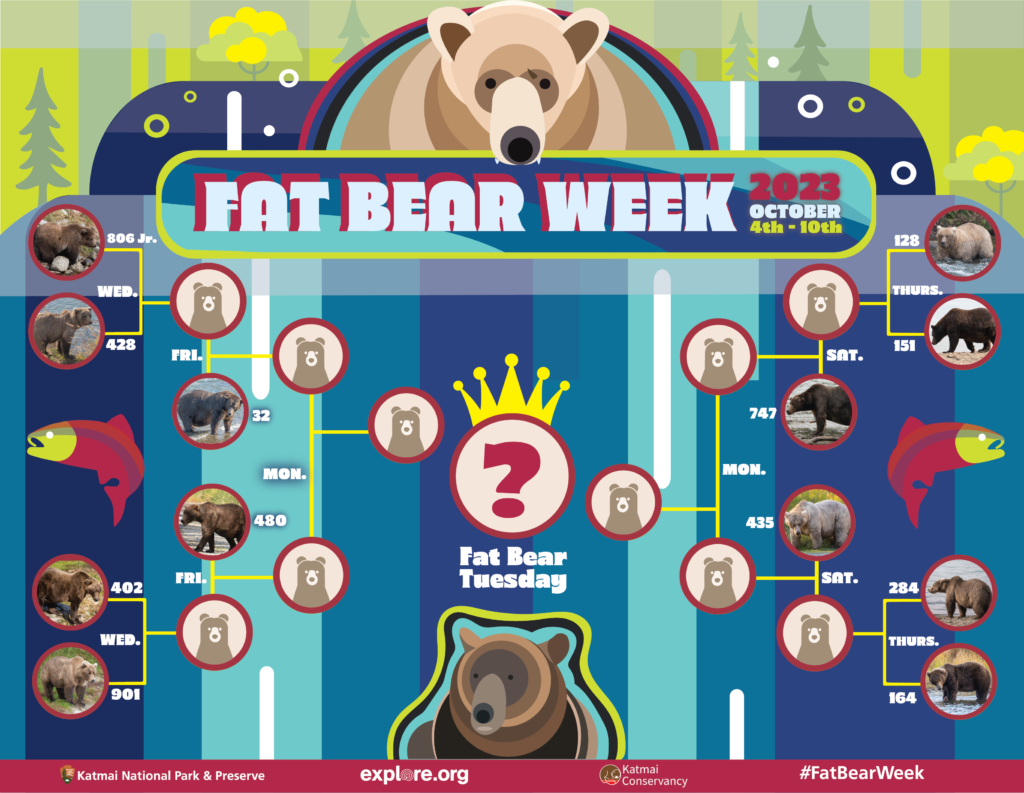
No, this has nothing to do with project management, product management, or academia at all. Instead this is a celebration of one of my favorite weeks of the year, Fat Bear Week! Voting starts today!
The brown bears of Katmai National Park in Alaska are expert fishers and eat boatloads of salmon to bulk up for the Winter. In 2014 a park ranger came up with the idea of a vote for the fattest bear and it was so popular it turned into Fat Bear Week a year later.
A short video on the history of Fat Bear Week
The bear cams on Explore.org are always a great watch as the bears eat their way through Summer (highlight here). I admit, I’m a sucker for a good nature live cam, but the bears ability to fish is epic. I’m pretty sure pro fishermen are jealous of that talent. For bears fat means survival through Winter hibernation, so all that eating is not just enjoyable (looks pretty enjoyable, kinda like I devour some great Indian food) but crucial to their successful Winter nap.
Side note: I’m pretty sure I was a bear in a previous life. In the Fall all I want to do is eat all the food and then sleep through Winter. Why don’t humans hibernate?
Like March Madness? You’ll love this one.
I’ll be honest, I’ve had a not great year so far and for me Fat Bear Week is the chance to get distracted by a bunch of brown bears out there making a living and keeping it real. If you need a distraction or you just love looking at big, beefy bears this is your week. Join me, and let’s celebrate the wonder of nature and the beauty of these bears.
I gave a short presentation to my unit yesterday and thought that perhaps others might be interested. You can find it in the CORE repository, and if you have further resources or comments feel free to send them my way.
In prep for a discussion later today with colleagues on Mastodon I created a little cheat sheet that I thought might be helpful to others. Check it out below.
Resources and general information:
Fedi.tips – An unofficial guide to Mastodon and the Fediverse
Author note: This blog is crossposted from the HuMetricsHSS website. I am the digital specialist on the HuMetricsHSS team and the project manager on the Commons platform.
I’m the digital specialist for HuMetricsHSS and I wanted to talk a bit about how both our values as a team and my values work together to inform our work. I was delighted to attend the 2023 axe-con conference last week. Axe-con is an accessibility conference organized by Deque, a company that provides accessibility testing, tools, and education to the developer community. It is a free conference, and all of the sessions are recorded. Those who missed it can still register for free and access the content, and if you have interest I highly recommend it. Attending the conference has underscored the need to make a more concerted effort to make inclusive design an integral part of our process.
One of the things this team has tried hard to do over the years is to make digital accessibility part of the process from the beginning. While our digital tools are not perfect (nothing ever is!), we’ve made a number of updates to work toward being fully accessible including working to ensure that full text descriptions are available on non-decorative images, using non-color indicators for links, creating closed captions for all of our videos, and adopting the Atkinson Hyperlegible font for the visually impaired for all of our digital products (including PDFs). When crafting our white paper, Walking the Talk, we ensured that all of our interactives and graphs had proper descriptions, the PDF versions were screen reader-compliant, and that the online version of the paper on Manifold had the ability to adjust text size and contrast. We’re currently starting the process of another major redesign of our website (the current version launched in July 2020) and will work to build on this foundation.
In my role as digital specialist, and as a librarian with a background in information management and user experience, the axe-con conference has been a source of actionable information on the ways in which we can work to make the digital world a more equitable place. It’s one thing to state your values, but enacting them requires deep consideration and work. UX research and evaluation is often overlooked in the interest of completing a project quickly while controlling the costs of development. We are a small team, and our website is not terribly complex. That said, understanding the needs of the wider community is an opportunity to engage in a deeper and more meaningful way. As we think through the information architecture and new design of the website we will involve a wide range of community members throughout the process. This structure will allow us to test out features to determine the usability and accessibility of content.
In thinking through how to enact our team values in regards to our digital work, I’d like to consider the ways in which inclusive design makes technology better for everyone.
Inclusive design is a design process in which a product, service, or environment is designed to be usable for as many people as possible, particularly groups who are traditionally excluded from being able to use an interface or navigate an environment. Its focus is on fulfilling as many user needs as possible, not just as many users as possible. (Joyce, 2022)
Alita Joyce, Nielson/Norman Group
Closed captioning on television and video, for example, was originally developed for the Deaf and hard-of-hearing community yet many hearing people use captions for all sorts of reasons, including not disturbing our family members or neighbors when living in a communal space. By engaging in inclusive design, we improve the overall experience for everyone.
Things to Think About
According to the US Centers for Disease Control 2022 statistics, about 26% of Americans have some type of disability. That includes 11.1% who have mobility issues (that could impact the use of a mouse or keyboard), 10.9% have cognitive issues (that can include dyslexia, dyscalculia, mental illness, brain injury, and stroke), 5.7% who are hearing impaired, and 4.9% who are vision impaired. The effects of long COVID may yet cause these numbers to rise and many are still experiencing brain fog, fatigue, and even mobility and nervous system issues.
For me this is professional and personal: I am a person with disabilities, one of which is temporary while the other is permanent. While attending this year’s axe-con, I’ve dealt with the wrist of my dominant hand in a brace due to a temporary injury that makes using a trackpad and typing difficult. Thankfully, a voice-to-text application has been helpful in writing this blog. The video recordings of sessions and the transcripts provided at axe-con helped me to participate fully without taking the detailed notes I normally take at such conferences. In addition, I also have dyscalculia, which is a cognitive disability that involves the understanding and comprehension of numbers and mathematics. It wasn’t until I was a junior in high school that I was diagnosed, and it is something that I continue to deal with as an adult. Funny enough, I’ve found that the Atkinson Hyperlegible font that the HuMetricsHSS adopted last year, which clearly differentiates numbers from letters like 0 and O, is helpful to me when reading text. While my mobility is temporarily impaired, my difficulty in doing math and remembering numbers in sequence is permanent. Most of us will likely experience a temporary disability at some point in our lives, while others may experience age-related vision, hearing impairments, and mobility issues that become permanent. Understanding the ways in which I have used technology and tools has positively impacted the way I look at solving access issues professionally.
The Values at Play
The HuMetricsHSS values framework includes the values of equity and community. In her 2023 axe-con keynote, disability activist Imani Barbarin discusses the importance of involving the community as a co-conspirator and partner. By not involving disabled people in the process Barbarin states that we are essentially engaging in discrimination. Accessibility is not something that can be achieved through following a checklist, and disabled people are diverse in population and ability. We must engage and involve the community and not just rely on guidelines and requirements to truly achieve equity by being intentional about how we go about it. While things like the W3C’s Web Content Accessibility Guidelines (WCAG 2.1) and the Americans with Disabilities Act (ADA) are a good start, involving disabled people in the process early and throughout the process is key. Michelle Williams’ excellent session on UX research, Research Through Broken Lenses: The Need to ‘Shift Left’ in UX Research, and BARD Mobile’s session, User Research and Personas for BARD Mobile, offer actionable paths forward in involving and including a wide range of users with varied abilities in the design and throughout the build of a project.
As the team member primarily responsible for our digital work I admit that I am not an expert in inclusive design or accessibility but I am learning more every day. In addition to working on HuMetrics I am also the project manager for Humanities Commons, which is also beginning its own redesign and expansion. I work regularly with our Mesh Research/Humanities Commons UX researcher and together we are working with colleagues at Michigan State University who actively engage in this work. One of the reasons I wanted to write this post is to engage our community in helping us be inclusive and also to hold us accountable.
The HuMetricsHSS team often discusses how to enact our values when working on any project or idea. Our digital tools and presence are no different. As we begin to think about what our next public face will look like we will reconsider everything from our color palette to the ways in which we use language. Moving forward we will be intentional about including a diverse range of users, including our disabled community members, from all of our intended audiences. The HuMetricsHSS team will make every effort to recruit a diverse set of users for feedback on our designs and functionality in our pursuit of inclusive design as we move into our website redesign project. More importantly, we will work to ensure that all aspects of our website (and any other digital products, including white papers and our workshop kit) meet and exceed accessibility standards by enacting our values of equity and community.
If you are interested in assisting us with evaluation and testing please let us know! Our community is key to ensuring that we create a space that is both welcoming and useful to all.
The AI blog post had some traction and I realized that it would be much easier to continue the collection if I moved it to a Zotero. Find the collection in the menu as “AI Controversies” (under Projects in the main menu).
I plan to continue adding to it as I find articles and papers. Please feel free to pass further content on to me for inclusion in the collection.
Update 3/28/2023: An updated version of this list can be found in AI Controversies under Projects.
As a librarian in higher education who works in scholarly communication I’ve been watching the increasing use of ChatGPT in both journalism and in the creation of papers and research. Below is a list of articles on the topic from the last three months that highlights some of the concerns. If you’ve come across other articles (in any language) pop them in the comments. I’d love to keep the list going as a resource for anyone whose organization is toying with the idea of using AI to generate content.
Over on the Building the Commons blog I’ve posted the first in what will be a series of blog posts on project managing complex, grant-funded projects. From the post:
I’ve wanted to start a discussion on the project management of ambitious, nebulous projects that seek to fundamentally change the way we work. Over the next few months in this blog series, I’d like to explore what managing a project like Humanities Commons entails, the ways in which large projects like these are different in the ways they’re funded, staffed, and developed, and how we might define new ways of thinking about and creating structure around them.
The OER is designed to increase understanding of how a values-based approach to scholarly communication can address the challenges of publishing publicly engaged scholarship, with particular emphasis on humanities and social sciences.
The focus of this resource is primarily on the underrepresented area of publicly engaged scholarship. It addresses a wide range of MLIS students and LIS professionals based at universities, especially those whose mission explicitly encompasses engaged scholarship initiatives. The resource also spotlights publicly engaged publishing initiatives that provide examples of scholarly communications projects with social justice values such as equity, access, fairness, inclusivity, respect, ethics, and trust deeply embedded in their design.
I co-authored the OER with Kath Burton (Routledge, Taylor & Francis) and Catherine Cocks (Interim Director, Michigan State University Press). We had a lovely time creating it and can’t wait to hear your thoughts!
As a librarian, I think a lot about how to ensure access to information of all kinds. Prior to joining the Humanities Commons team, I spent almost 10 years in scholarly publishing, and I grew increasingly concerned about the sustainability of current publishing models. There is a growing barrier to access for many who are not affiliated with institutions or who are at institutions that simply can’t afford the increasing subscriptions in the current market.
For me, the joy in OA is bringing information to everyone, regardless of position and financial means. OA allows everyone equal access to information, and at the same time it empowers everyone to disseminate their work widely. OA levels the playing field. It connects global collaborators, and it allows those who want to research and create to build on the work that has come before.
Scholarship is becoming increasingly multimodal. Undergraduate students in the humanities are taught not just writing, but often work with audio, video, and video games. As these formats continue to grow journals and monographs won’t disappear, but they will come under increasing competition for views. OA offers these students and scholars the ability to share their work widely when many publishers simply can’t find a way to publish these new formats. My joy at this moment is being a part of the Commons and working to think about not just what’s happening now, but how we can support these new formats in the future.
and that’s dangerous. I’ve been thinking a lot about what I want to say here. That means I haven’t said anything, because I’ve gotten stuck in the thinking part.
I’d like to talk a bit about what it’s like to manage large digital projects and platforms that are unlike what have come before. There are no guidelines, no roadmap, and no formal system that’s a perfect fit.
I’m planning to talk about the challenges, the joy, and the real work that it takes to work collaboratively with a team. Thinking through the implications of what seem on the surface to be small decisions that end up having large ripple effects. Talking about the struggle to identify your values and to enact them, and the mistakes made along the way.
I hope you’ll come with me. I can’t promise to be prolific, but I hope to use this space to create dialogue and to think through what it means to do this work.